If you have also planning to start a...
Read More

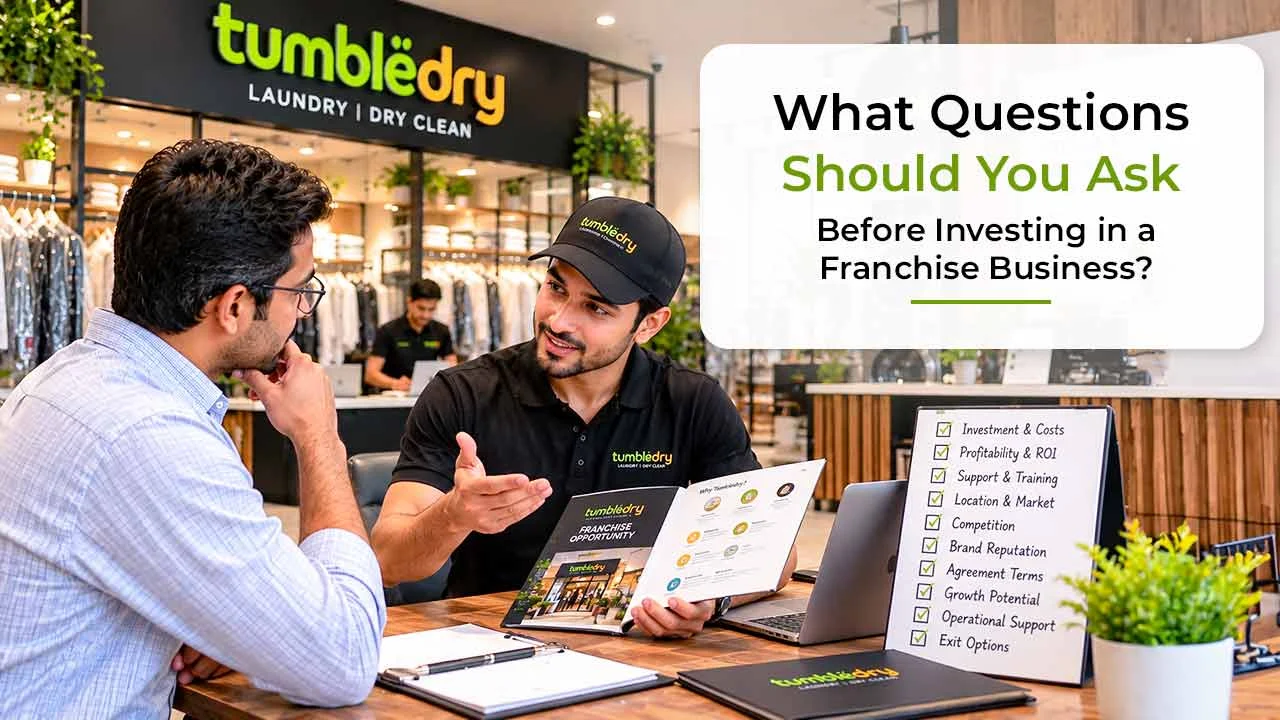
Before investing in a franchise, ask questions in five areas:
Check the answers against public data such as MCA filings and Google Trends.
Buying a franchise means buying into someone else’s system. This guide lists what to ask in each area, what a good answer looks like, and which answers should make you walk away.
Area | Key question | Good sign | Red flag |
|---|---|---|---|
Proof of concept | How many working stores exist, and in towns like mine? | Hundreds of stores running for years, including similar towns | Few stores, or only metro stores |
Company strength | Is recurring royalty revenue growing year on year? | Royalty income rising every year | Growth driven only by new franchise fees |
Leadership | What have the founders achieved before? | Proven track record, verifiable background | Vague or unverifiable history |
Post-launch support | How many days of on-site training and launch support? | Dedicated partner-success team, weeks of on-ground help | Support ends on opening day |
Your judgment | Did the team answer directly and confidently? | Clear answers, including to small questions | Repeated “we’ll get back to you” |
Want heavy returns on investment?
Get 65% ROI!
This is the most basic question. Check that real, working stores exist for the business you are being pitched.
The number of working units matters most. Inflated claims do not survive across hundreds of locations. A large count of stores that have run for years is the strongest sign that a model works.
Next, ask whether it will work where you are. A model that succeeds in metros may fail in your town, and the reverse is also true. Ask the franchisor:
If the business works in many towns like yours, that is a strong sign it will work in yours.
For Franchise Queries
You are investing in the company as much as in the idea. Four checks reveal its strength.
A longer track record means the company has survived more ups and downs. If it is still growing after several years, it has learned how to handle problems. Age signals organisational maturity.
Many franchise brands keep costs low by cutting support staff and focusing only on selling stores. A large team in roles other than franchise sales shows the company invests in its partners’ success.
Use Google Trends, which is free. It shows how often people search for a brand by week, month or year, and by state or region.
Most Indian companies file annual financial statements with the Ministry of Corporate Affairs (MCA). You can buy them for a small fee from the MCA portal. First check whether turnover grows year on year. Then split turnover into its two parts:
Revenue type | Where it comes from | What it tells you |
|---|---|---|
One-time revenue | Franchise fees and setup income from new stores | How fast the company is selling franchises |
Recurring revenue | Royalties from existing partners’ sales | Whether existing partners’ businesses are growing |
The key test: if royalty income grows every year, partners’ revenues are growing, and the company grows with them. If recurring revenue is flat while franchise-fee income rises, walk away. That company lives on selling new stores, not on its partners’ success.
Leadership may be the most important question of all. Indian aviation shows why.
Every Indian airline:
Yet IndiGo became India’s largest airline, while Kingfisher Airlines (2012), Jet Airways (2019) and Go First (2023) shut down. The difference is not what these airlines did but how they did it, and leaders decide the how.
Check the people running the franchise business:
Proven leaders handle uncertainty better, and strong credentials at the top improve your odds.
You still have a chance to join one of India’s largest & fastest growing franchise.
Most brands pay close attention during setup. What matters is what happens after launch. Ask:
A higher share of staff focused on partner success shows the company wants partners to survive and grow.
Then ask about training. Training can be structured, in person or virtual. The most important question is: how many days, weeks or months of physical, on-site training will the company’s own staff give you? On-site training is the most valuable kind, and the longer it lasts, the better your chances.
Don’t evaluate one brand on its own. Put the brands you are considering side by side and ask each the same questions. Google Trends can compare up to five brands’ search interest in one chart.
Revenue type | Stronger sign |
|---|---|
Working units | More stores, running for longer |
Years in operation | A longer track record through ups and downs |
Presence in towns like yours | Named, working stores in similar towns |
Search interest (Google Trends) | Higher and rising in your state or region |
Recurring (royalty) revenue | Growing year on year in MCA filings |
Staff on partner success | A larger share of the team |
On-site training | More days of in-person training |
Leadership | Proven records in earlier ventures or jobs |
You can join India’s largest laundry and dry clean chain & get assured profits.
The final question is one to ask yourself. After your meetings, rate the people you dealt with:
How a franchisor’s team handles your questions before you invest previews how it will support you afterwards.
Every franchise has trade-offs. These signals mean the risk is higher than it should be:
Red flag | Why it matters |
|---|---|
Few working stores, or none in towns like yours | The model is unproven where you plan to invest |
Revenue growth from franchise fees only, flat royalties | The company earns from selling stores, not from partner success |
Promised returns stated as guarantees | Real results depend on location, rent and execution. Honest brands give ranges and disclaimers. |
No access to existing partners | You cannot verify what partners actually earn |
Support that ends at launch | The first 3 to 6 months decide whether a store survives |
Unverifiable leadership background | You are trusting people you cannot check |
Pressure to sign quickly | A good franchisor wants the right partner, not the fastest one |
If you are evaluating Tumbledry, here is how it measures up on each area. Ask us to back up every line.
Question | Tumbledry’s answer |
|---|---|
How many working units? | 1,500+ operational stores across 600+ cities (Sep 2026) |
Does it work in towns like mine? | 600+ stores in Tier 3 and Tier 4 towns, from Bhagalpur and Karnal to Darbhanga and Bandipora |
How old is the company? | Founded April 2019; about 1 new store a day since 2024 |
How fast do stores stabilise? | Operational break-even in 3 to 5 months; 95% of stores reach it by Month 3 |
Who brings the first customers? | Tumbledry guarantees 200+ customers in Year 1 through its own digital ad campaigns; many stores reach 1,200 to 1,500 customers |
Do customers come back? | About 50% of customers order every month |
What training do staff get? | Every washerman and ironman completes a 15-day certification at the Tumbledry Academy |
How big is the team? | 500+ people across operations, training, marketing and technology |
Independent recognition? | Ranked #1 in India and #5 globally by CINET; first Indian laundry brand to win CINET’s PTC Award of Excellence – Entrepreneurship (Milan, 2022) |
Year | 2019 | 2020 | 2021 | 2022 | 2023 | 2024 | 2025 |
|---|---|---|---|---|---|---|---|
Stores | 23 | 77 | 172 | 435 | 717 | 1,063 | 1,430 |
Evaluating Tumbledry? Ask us every one of these questions.
Start with proof of concept: how many working units exist, and are they in towns like yours? Then check whether the company’s recurring royalty revenue is growing, which shows whether existing partners are succeeding.
Most companies file annual financial statements with the Ministry of Corporate Affairs. You can buy them from the MCA portal for a small fee and review turnover and royalty trends.
Turnover that grows mainly from franchise fees while royalty income stays flat. It means the company earns from opening stores, not from its partners doing well.
There is no fixed standard, so compare brands. Ask how many days of physical, on-site training their staff will give you and your team. More on-site training improves your chances.
Ask whether the company has researched your territory and how it defines the target customer. Then ask for similar towns where the model already works, and speak to partners there.
Yes. Existing partners are the most honest source on real earnings, support quality and problems. A franchisor that won’t connect you with them is a red flag.
It shows how often people search for each brand, by state or region, and lets you compare brands in one chart. Rising search interest in your region signals real customer demand.
No. Returns depend on location, rent, execution and local demand. Trust brands that give ranges, disclaimers and access to existing partners over those that promise fixed returns.
Disclaimer: The opinions expressed in this article are those of the author. They do not necessarily purport to reflect the values or views of Tumbledry.
If you have also planning to start a...
Read MoreIf you have also planning to start a...
Read MoreTier 3 cities in India offer untapped business...

Read MoreThis blog explores ten innovative and emerging small...

Read MoreIf you are not happy with your regular...

Read MoreGo through these best and simple home business...
Read MoreVijayawada which is a prominent city in Andhra...

Read MoreUnderstanding what is ROI and how to calculate...

Read MoreUnlock unique business opportunities in small towns in...
Read MoreSubscribe to us:
Sign up to get more such information & get the best deals on professional cleaning
Shoe material analyzed to decide the cleaning methodology.
The laces, sole, and other removable parts are separated to be cleaned individually.
Any spots or stains are removed with German organic chemicals.
All the bacteria, viruses and bad odor is eliminated.
Shoes are Air Dried, Blow Dried, or Sun Dried depending on the skin type.
Shoe skin is nourished & enriched with our unique natural oil based polish
Once polish is dried, our experts reassemble all shoe parts and pack them for delivery.
Try it once to feel the difference
Carpet Cleaning
An intense, deep-cleaning of carpets to restore their original glory
We specialize in dry cleaning of Persian rugs, silk & Turkish carpets, and all other premium, imported rugs of nylon, wool, cotton, polyester and olefin.
WOOLENS DRY CLEANING
Our Woolmark approved Lagoon system is the world’s most advanced and eco-friendly technology for dry cleaning woolen garments – sweaters, coats, furs, shawls, pashmina, and jackets.
Your woolen garments will be delivered stain free, and will retain their original texture, smoothness, fluffiness, shape & size. Our advanced systems and processes ensure zero shrinkage.
For expensive and delicate woolens like furs & pashmina, we use special eco-friendly chemicals from Germany which are of neutral ph, and form a protective covering around wool fiber to maintain its shine & lustre after dry cleaning.
CURTAIN CLEANING
Premium curtain dry cleaning service service with facility to remove the curtains from rods and install them back after dry cleaning.
Leather Dry Cleaning
Professional leather dry cleaning for jackets, bags, purses, clutches, wallets, belts, shoes, boots and stilettos.
Protect your leather items from dirt, dust, oil stains, perspiration, dehydration, mold & mildew.
Our expert leather care technicians inspect each item with utmost care to assess the color, shade, and type of leather, and accordingly decide the most appropriate treatment.
Complimentary conditioning and polishing to ensure smooth & shining finish
Shoes/Bag Cleaning & Restoration
Experts in dry cleaning of Sports, Canvass, Leather, Suede, Nubuck Shoes, Sneakers, Boots, Sandals and Canvass, Jute, Leather & Suede Bags
Following Restoration Services are also available: